Wednesday, June 03, 2009

Baby Optima's first date


Into the EV Archives we go, for a little more history on Godzilla #003 and our Baby Optima coolant reservoir, who first met each other under the hood of John Wayland's White Zombie, which is the world's quickest-accelerating street legal electric conversion, having covered the standing start quarter mile in 11.466 seconds, with a best 60-foot time of 1.58 seconds!

http://www.plasmaboyracing.com/reviews.php#2007s


Of course, back in '97 our Baby Optima was a working prototype issued as sponsorship to the most notorious electric racecar around. It's nice that Baby O can live on in an EV with a new, and even greener, cleaner mission- holding green Zilla blood!

http://www.plasmaboyracing.com/reviews.php#1997

But it wasn't done, was it?


Not quite, but here's a summary of the past year's progress that lead up to the test drive.

Zilla Cooling: Thanks to excellent component selection by Ryan Bohm of EV Source, I mounted a super durable and quiet pump below the custom Baby Optima Coolant Reservoir, and fabricated a inner fender wall out of 1/2" HDPE, yellow of course. In this, I cut two portholes, and mounted a double-wide PC radiator and single cooling fan such that air is pulled in on one side, and exhausted on the other.

Another unfinished item was the Jim Husted-created Adjustable Brush Ring timing handle. It was not built with a method of securing it, as I thought I'd add a remote cable or servo control. However, inthe interest of simplicity, and wanting to allow enough learning time before risking Blowing Something Up (because I didn't have to), I built a jackscrew mount onto the motor, enabling easy adjustment, but not on the fly. Hand-fabricated from brass and polished to a high sheen, it sets off the motor nicely.


Lastly, the monster 12 pole disconnect switch from a power station was installed under the dash. Upon energizing the circuit, a current leak was discovered. So, the body is hot. Full pack volts, but no measureable amps, but I'll have to get that source identified ASAP. Good friend Stephen Johnsen became extremely frustrated by a similar fault, only to eventually find that some black rubber hose that was being used as chafe guarding was actually somewhat conductive! (a lotta carbon black in that compound!)

It's ALIVE!

Sorry for a year of silence- it's been quite a ride, including the birth of baby #2; our son Jason, a corporate downsizing and unemployment, a new job and lots of associated training, and in short, not much time for the poor, neglected Karmann Eclectric. But lo, our hero returns, and his steed awaits.
We got a couple of work sessions in during the break with helpful buddies (thanks Hans and Wayne, more details on that later), but the momentous date of May 31, 2009 marks THE BIG milestone. Karmann Eclectric moved under it's own 240V power!
Like it's namesake, Godzilla #003 awoke from a long hibernation and started tearing up the neighborhood, having retired from racing in White Zombie in early 2005.
http://www.plasmaboyracing.com/reviews.php#2000l
Without so much as a hiccup, the old controller came to life with that signature ZIlla "whoosh", and propelled the Ghia out of my man-cave.
I navigated a few speed bumps, relieved that he carefully-engineered 5" clearance held up after loading batteries and driver, and as I passed the immaculate gardens of our Homeowners Assoc. president, she gleefully greeted me with "It MOVES- but it's SOOO Quiet" She requested a ride, even though the passenger seat had not been installed. Not realizing the import of my recommendation that she hold on, our first passenger did half of a reverse somersault when I hit the go pedal!
Thankfully, the lexan battery covers prevented a plasma-imprinted tattoo on her back.. Cackling gleefully, she exclaimed joy and wonder for the whole neighborhood to hear, and then assisted me in discovering that the suspension height was no longer sufficient to clear our speed bumps. Thankfully, no real damage, as the lowest point under the chassis is just some solid stainless acorn nuts that grooved the asphalt...
No video of our adventure exists, thankfully, but the second run will be recorded!

Friday, May 30, 2008

The Ghost Dancer Glides Again!


You may recall that my non-electric Ghia, the 1965 Cabriolet "Ghost Dancer", had an unfortunate encounter with a red Dodge in September of 2006. Well, after a year in the bodyshop, a new job, relocation, and a second baby, the Ghost rose again today, after only 20 months in rehab. It is pictured here next to Ruthie, my 22 month-old daughter (3 month-old son is off-camera, date stamp on photo is wrong). Of course, some minor details remain to be completed, like installing an interior and bumpers, but it looks as good and drives better than ever, with a freshened tranny and new rear brakes to boot.

Sunday, September 09, 2007

Make a what outta who, take two? (or, the reincarnation of baby Optima)


THE SURGEON
(note the maniacal look of glee...)


THE PATIENT

(already looking deceptively young)


Creative retasking of salvaged components is one of the more satisfying aspects of this project for me, and the prototype Baby Optima had been bugging me for a while. The yellowtop color and tidy size that fit perfectly atop the original VW air cleaner stand were too good to pass up. Besides the prototype being an interesting footnote in EV history, this particular baby had cranked up John Wayland's generator cart during many record-breaking races. However, rebuilding it as a battery out of Cyclon cells, though clever, would give only an 8.0 Ah battery, not much reserve capacity should the dc-dc EVer conk out. Also, it was on the wrong side of the motor bay for clean wiring, and the position of Godzilla 003's coolant pipes were just begging for a reservoir atop that stand. So, I accepted; bent to the will of Zilla, and decided to convert the little Optima into a coolant reservoir.
Now, this battery had been sitting for years, it didn't get above 10v when I hit it hard with a recharge, and had been purposely shorted out for a couple of days to prepare it for decommissioning. HowEVer, sitting unconnected overnight, it actually recovered a bit of charge. What's the worst that could happen, eh? So I went to it with the hacksaw, and when the blade started to sparkle, I went ahead and checked voltage. 8.56, not too shabby for a battery with a sawblade shorting out three cells!

Cutting off the top was easy enough. Slicing throgh the cell interconnects was the only work involved, as they wanted to send the blade off course.


With the top off, the little six-pack lay exposed to the world. Of note, is that one cell was discolored in comparison the the rest, perhaps the reason that the battery wouldn't charge up.


Extracting the spiral cells proved to be a challenge. I screwed in the largest lag bolt I could find, and the cell sizzled with displeasure, but the big screw simply pulled out of the matrix when pried up with a crowbar. After several short starts (yes, a very bad pun...), I wound up simply drilling out the contents of each cell with a large spade bit, simply shaking and prying out the contents after they were shredded and loosened up. I didn't get an entire spiral cell suitable for dissection, but the following photo shows one section, complete with a piece of grid, the reddish-brown electrolytic paste, and the tyvek felt separator.


After extracting the lead and bagging it for disposal (this should be an interesting negotiation with the battery recycler), I cleaned up the case (wiping instead of rinsing or sweeping in order to minimize dust and water contamination, and securely bagging the paper towels for disposal).


To get the case ready for reuse, I squared off the top edge, which was pretty ragged from my hack job, with a belt sander. I also used a sautering iron to melt the plastic back into a couple of nicks and pinholes incurred while drilling out the contents. Then a Dremel tool was used to trim the remaining case material out of the battery top, and I cut off the hollow lead battery posts flush with the lid, in preparation for mounting hose nipples. Multiple hardware treks and redesigns were required, but in the end, I used 90 degree barbed fittings, threaded into the battery posts, and epoxyed a brass pickup tube into both fittings. (Yes, brazing would be better, but my torch was out of gas.) This way, the direction of flow doesn't matter, there will be no splashing sound, as there would be if the coolant return wasn't plumbed under the surface, and the warm coolant will be returned to the bottom of the reservoir, encouraging convection currents. However, the biggest encouragement of all for thorough mixing will be the pattern of holes I drilled as coolant passages within the reservoir. I also cut the bottom of each tube at a sharp angle so that ht tube would nearly touch the bottom of the reservoir, but have less potential for suction against the bottom or blockage by silt.


All that remained to do was seal on the top with silicone, mount the reservoir on the stand, and hook up the plumbing.
Keen observers will note that the 'positive' coolant fitting has not been connected. Installation of the coolant pump and radiator still must happen, and as with all else on the Karmann Eclectric, that involves some custom fitting, and must wait for another day!!
I case you're wondering about how this system will be filled and purged, there are actually two vents in the top of the Optima case. One, the grey porous ceramic disk that only vents under pressure, and the other, a 1/8" diameter 'straw' that stuck down into the battery about an inch. I cut this off level with the top so that it will vent air instead of liquid, and will rid some sort of porous cap for it (visible inside the rectangle atop the Optima lid). The vent will be the highest point in this system, so it the cooling system should purge itself. Initial filling will be through the upper hose, but coolant can be topped off through the vent hole.


Thanks for Reading,


Jay

Saturday, August 25, 2007

A spasm of Progress?

Yes, dEVoted fans, Karmann Eclectric has been sorely neglected for the past year, but another burst of energy came upon the scene with the return of Roy LeMeur from his midwestern sojurn. Yes, the National Electric Drag Racing Association NW Race Director is also a travelling EV mechanic, and the departure of wife and baby for my in-laws' for a week created a window of opportunity for real progress. Roy's schedule was fortunately in sync, and he spent a week at Casa del Donnaway to provide a boost to this project. Unfortunately, work demands kept me away from the garage for way too many hours, and we didn't make as much progress as planned, but it was a good time nonetheless.
Major tasks accomplished included routing, cutting, crimping and connecting all high voltage cables, re-mounting the Godzilla 003 motor controller on a new, improved and more precisely positioned base, placement of the main contactor, fuse and shunt, and installing the DCP dc-dc convertor, which was acquired in good used condition from Bob Bath of Grant's Pass, Oregon. A goodly portion of our time was spent debating the merits of competing cable routes, and dealing with my reluctance to drill more holes into precious antique German sheet metal... We settled on very few new holes in the end, and a graceful routing of cables that minimized their length while keeping the layout very simple.

Here's a closeup of the motor compartment cabling. You can see that the pack Positive and Negative enter through an existing oval hole in the firewall, and Positive goes to the main contactor, then to the Zilla. Pack Negative goes straight to the fuse, through the shunt, and then on to the Zilla. Note that I used 2/0 red and black cables for the pack cabling, but massive 4/0 black cables (with the nifty polarity-indicating shrink wrap) on the motor loop. This is because the Zilla will be pumping out a massive 1800 amperes at 170 Volts, while the battery pack will 'only' need to supply something on the order of 1275 amperes at 240 Volts. It's amps that eat copper, voltage means more insulation!


If you look carefully, you can see that the DCP dc-dc converter, though not wired in yet, is mounted on a piece of 1/2" yellow HDPE board. Besides providing me with another opportunity to minimize the number of holes drilled in the car, the board provides another degree of electrical isolation, and just makes for a nice touch, in my humble but correct opinion.


One the opposite side of the motor bay, what do we see, but a rare prototype Baby Optima Yellow Top! This battery never made it into production, victim of GM's 1990's episode of EV extinctions... The lead inside this unit is beyond rescussitation, but the case may yet prove useful, as it matches my color scheme, gets major EV trivia points, and fits perfectly atop the vestigial VW air cleaner stand. I plan to cut off the top, carefully extract the lead (and document the dissection), and then either rebuild it as a 12V accessory battery using Hawker Cyclon cells, or just re-task the case as the Zilla's coolant reservoir. A baby Optima with green fluid pulsing in and out? Now that oughtta be worth a few double-takes!! Besides, I'm more likely to use the higher-capacity nicads I already have as a house battery.


We also completed most of the pack interconnects, and let me tell you, that's no small task when 2oo individual cells are involved. I shudder to think about assembling a pack for the tZero, with it's 6800 individual lithium-ion cells, or the new Tesla Motors battery pack, which just had to beat the tZero with 6831 li-ion cells.


The packs may look complete, but they still need safety covers, which will also function as hold-downs. I plan to use thick Lexan plates, but have to review this strategy for NEDRA rule compliance.


Here's a look at the nearly-complete rear packs, along with their wiring diagram. We had to add some plate steel under the packs, because the sheet metal boxes, though quite strong at the corners, sagged too much in the middle, which would have put stress on the interconnects and cell posts, possibly causing poor electrical contact or electrolyte leaks. By the way, the interconnects, which are custom-fabricated nickel-plated copper stampings designed by John Lussmyer, have been doubled up in order to handle Big Zilla Amps.

Thursday, April 26, 2007

Back in the Saddle, Again.

Soooo sorry it's been so long.

When we last posted, Karmann Eclectric's cousin, the Ghost Dancer, had been viciously attacked by a Red Avenger. Well, time has stood still for both cars since September. The Ghost Dancer was moved to storage at my favorite bodyman's shop; Definition of Image. Like many car restorers, you have to get in line early to tap the talents of Tracy Payes, so the Ghost hibernated all winter long in Boring, Oregon awaiting the tender touch of Tracy's grinder.... This week, progress began on the bodywork, and this past weekend, the Karmann Eclectric was also resurrected from storage at a long-suffering friend's. Bob Torrens graciously gave up some of his home shop to store the car during my relocation. Yes, besides the arrival of our firstborn in August (www.babyeclectic.blogspot.com), I accepted a new job in September, and spent the winter doing a weekly commute to Tacoma before relocating in March.

Karmann Eclectric's minimum 5" of ground clearance was sufficient to roll aboard the U-Haul car carrier without special considerations, but since I didn't bring along a come-along on the trip, we lifted the rear ramps in order to have a level runway, after getting all the advantage that could be had from the driveway's minor slope. Even though the car barely weighs a ton, pushing it up ramps is no fun! Note that having a working handbrake on your rolling shell is always a big plus, as is a buddy willing to donate his back to the cause!


Next: Project reorganiztion and rescussitation!


Wednesday, September 13, 2006

TAG, I'm hit.


My wife is a Veterinarian, and says that many dogs who get hit by cars come in with a full belly. It seems that they become a bit less observant while fat and happy. Well, that might be the case with people too. (No, my insurance agent, does not have this blog address- I admit nothing!) After a particularly satisfying breakfast on a beautiful sunny day, I decided to exorcise the Ghost Dancer, and brought 'er downtown. Crossing Broadway Avenue, the southbound lane was at a standstill, and some kindly drivers made space, waving me across. Now, I've seen this happen before, but visibility is always a challenge when nosing out of bumper-to-bumper traffic. Needless to say (so I'll write it), I got tagged by cross-traffic when the little Ghia emerged. Once I saw the Red (Dodge) Avenger approaching, I stomped on the gas, but couldn't get out of the way in time, and got solidly smacked in the rear passenger quarter. Sheetmetal damage was minimized because the Avenger hit my axle quite squarely. If I'd been hit two feet forward, the car would be totalled, and two feet aft, I'd be looking for an entire rear clip, and probably an engine as well.
Thank goodness for minor graces... Anybody need a used transaxle- cheap?

Monday, September 04, 2006

NEDRA Late Night Nationals

Now we come to Friday, August 24, 2006- the date that I had hoped to unveil the Karmann Eclectric before the amazed masses at Portland International Raceway. You see, for the first time EVer, the National Electric Drag Racing Association was holding it's national EVent under the lights at Oregon's premier track, and alongside some nasty gassers.
Well, though it's been a banner year for EV dEVelopments, the EVent was somewhat lackluster. No cars from outside the Northwest were able to make the long trip for this competition, and EVen our local ranks were somewhat thinned in comparison to years past. HowEVer, there was a fine shootout between White Zombie and Cal Poppy, Otmar's rolling testbed for Zilla Controller dEVelopment. Gone Postal made the trip down, and even made a couple of complete runs down the track (with others marred by blown components). To add to others' shame for not making it, Otmar piled on his record book entries by pulling a few batteries to get the Poppy down to 192V and claiming that record as well.
The much-anticipated return of Chris Paine of "Who Killed the Electric Car" fame was not to be, fortunately because his movie's widespread success extended the promotional tour.
But, we got an EVen bigger treat (sorry Chris). Car and Driver Magazine sent feature writer Ted West to get the skinny on this phenomenon of fast electric cars, and though he was fresh out of a Ferrarri feature, there was just no wiping that EV grin off his face after several drag duns at the wheel of White Zombie, and at par with it's recent record-breaking pace as well!

Here's Ted coming out of his first run- wouldn't that have been a great photo if I could shoot straight?

Next morning brough out the hungry masses for an all-EV Breakfast Show n Shine at the Village Inn Restaurant in NE Portland. I brought out the Karmann Eclectric, and fun was had by all.

Thursday, August 24, 2006

Disconnect This!


One component that is not currently available in an EV-specific form is a high voltage, high amperage circuit breaker and/or emergency disconnect. Each converter has to come up with his own solution, and they range from homebrew knife switches to springloaded Anderson connectors, to the simply effective industrial fuse holder used in White Zombie. I had the good fortune of being mentored by Dan Bortel, a local EV collector and recently-retired electrical engineer with an extensive collection of EVery imaginable form of surplus.
One of Dan's finds was a rotary switch from a huge Uninterruptible Power Supply. It is a set of four stackable contactors, activated by a springloaded, panel-mount rotary handle. The thing is rated for 600 volts, 200 amps per set of contacts. Luckily, the unit is made of lightweight thermoplastic, with most of the mass concentrated in copper and contact points. With four contacts in series, it should have no trouble handling anything I can dish out.

During the battery clamp fabrication with Marko, we whipped out an enclosure to mount this switch under my dashboard, and local motorcycle EV'er Damon Henry supplied some surplus busbar to link EVerything together!

Thursday, August 17, 2006

PFC20 Joins the Party


I had originally planned to place the Manzanita Micro PFC20 battery charger up front in the car, to have it close to the charging inlet (which resides in the old fuel filler, of course!), and that would have given me a pack voltage connection up front, which allows for mounting the dc-dc converter in clean dry place, and next to most of it's loads. However, there are drawbacks to having an extra HV run of cable going up front, and there was some difficulty shoehorning the charger in there. Instead, we opted to mount the charger on the motor bay firewall, squared up with Gamera and Godzilla. This puts all the pricey hardware incredibly close together, keeps cable runs to a minimum, simplifies the EV education mission, and also concentrates the eye candy. Thanks to the donation of high voltage standoffs and craftsmanship of Dan Bortel, PFC 20 is now sitting pretty. You'll notice that in this photo, the charger leads aren't yet connected, and the battery leads aren't in yet.

Sunday, August 13, 2006

A Cable for Mr. Gamera.


As sweet as the motor and controller looked sitting together, this union will never work without clear lines of communication. 4/0 welding cable should provide all the conduction required for a heated discussion, without letting the sparks fly!
Here is the 'motor loop', all cabled up, but not cinched down, and the heat shrink tubing has yet to be heated..

Wednesday, August 02, 2006

Godzilla Mounts Gamera (Rated G)


At last, this potent duo is joined!
You may recall that the Gamera Nine started off as a homely forklift motor, welded to a saddle for support. Since we went with a face mounting, the saddle wasn't required, but while Sir Jim was in a good mood (as he invariably is when playing with copper and steel), I got him to cut away that saddle, but not before drilling and tapping a set of holes for remounting the saddle, on either the top or bottom of the motor, should I so desire an accessory mounting platform.

I built some brass bracketry by bending straps around scrap wooden blocks and auto body dollys. Not only did they match the brass motor cable studs, but provide a bit of additional vibration isolation, with rubber washers and some built-in spring action... The advantages of this setup include minimizing the high amperage cable runs to all of ten inches, a compact and straightforward layout, no boring of holes through the fresh bodywork, and the perfect placement of Godzilla's cooling water manifold next to the Ghia air cleaner mount, upon which I will place the retasked oil bath air cleaner as a coolant reservoir, coolant pump, heat exchanger, and cooling fan.

You may have also noticed, by looking closely at the last photo, that the motor clearance against the rear valence is very tight. As a matter of fact, it was too tight. After all that measuring and machining, I wound up having to add a couple of shims to the transaxle mount, and that was all it took to push the motor back into the valence. However, the damage was minimal, and to prevent removal of too much material, I hand-filed the profile, and test fit it many times to achieve the result shown.

Thursday, June 29, 2006

A clutch in a pinch?


Now that the Gamera is ready for action, it comes time to finally install the taperlock hub, lightened flywheel, clutch, and pressure plate. So, with great enthusiasm and confidence I put on the hub and then the flywheel, being careful to properly position the hub on the shaft as close in as I dare, and to slowly tighten the allen screws in a crosswise pattern. Besides, taperlock hubs are self-centering by their very nature, right?
Beautiful as it may be, when the above assembly was test-spun, it wobbled like a wounded duck, so this midnight escapade ends with Gamera back on the bench, the Bentley shop manual open for study, and Bug Me Video awaiting a less bleary-eyed mechanic.

7/1 Update- With the sage advice of Jerry at Autosport International, (and the use of his air wrench) I was able to get the flywheel mounted true. Turns out that the winning technique involved remounting it a couple of times, rotating the hub 90 degrees each time, until I found the 'sweet spot' where the respective idiosynchracies were cancelled out (down to 0.002").

7/2 Update- But of course, solving one problem only leaves one free to find another. I've a nice stash of parts to pull from, like any aircooled enthusiast, but not the experienced eye to tell early from late clutch parts, especially with some racing and one-off versions thrown in for good measure. So, two motor installations later, I've got one mangled pressure plate, a scarred guide cone, and a non-functional clutch.. Time to go to the guru again. Besides, I need a bowden tube before that clutch will engage smoothly, even if I manage to escape without buying another throwout bearing, pressure plate, or clutch disk..

Wednesday, June 28, 2006

Gamera gets back into the game..

When we last saw the Gamera Nine motor, it was winging it's way back to Jim Husted's custom motor shop on the Wayland Express: a free motor delivery service courtesy of Plasma Boy's good graces. Note to self- when taking advantage of the generous services of a fellow finickey hobbyist, make sure to brief him on any pre-existing conditions present on the package. You see, I forgot to tell John that I had put a nasty scratch in the motor's fresh finish when my jack slipped during a test installation. When Plasma Boy noticed this mark a day later, he about let his own smoke out, and confessed his apparent crime to Jim, who knew about the scratch and had a good laugh at John's expense! John, I owe you one.

Since the body was not expected back anytime soon, Jimbo had full clearance to keep this project on the back burner, and sure enough, between then and now, he's refined his art even further, having seen several other suicidal EV'ers torture their motors before me. So this time, the Gamera comes back with not just the planned high-speed balancing job, but also a kevlar-wrapped commutator! After seeing the disastrous impact of involuntarily high rpms on com bars (they try to fly), Jim came up with a great technique to tie them down by machining a groove in-between the brush contact areas, and wrapping in some super-duty kevlar thread. (So the com gets baked, again.)
I finally consented to cutting off all that extra tailshaft, so now Gamera's stinger is no more than standard ADC spec. However, besides the aforementioned, additional extra touches include zilla green powdercoated springs, teflon-insulated heavy duty brush leads, and the Gen III Variable Brush Ring Assembly (now with fewer conductive components!). Instead of a wrapped steel handle and pointer, the Gamera now sticks out it's tongue, a fine red resin paddle, which will much more easily accept a control cable in the future.

Wednesday, June 21, 2006

Karmann Eclectric: the Convertible?

No, I didn't lose my top, but we did loosen the rear.
In order to greatly simplify the installation and servicing of my motor, and to leave open as many future options as possible, the Karmann Eclectric was reworked with a removable rear valence. Now, a removed rear valence is often seen on drag racing VWs, since it simplifies engine removal (which is a fairly frequent task on these ICE beasts), but usually looks like a hack job. In the Eclectric, it allows me to more easily install the motor, and to do so with a minimum of scarring. (all other EV Ghias thus far have had to cut a notch out of the motor decking...)
And besides, you never know if I might want to upgrade to a bigger motor someday, say a Kostov, or EVen a Warp Thirteen! Then I could just leave the valence panel off and have a big honkin motor sticking out the rear....

Seeing Green

You may recall that the Gamera Nine motor was reborn in Zilla Green, in honor of the world's fastest DC EV controllers, the Zilla series of scorching silicon by Cafe Electric.
Well, since the Karmann Eclectric is all about (revisionist) history, a simple off-the shelf model wouldn't quite fit the bill. Instead, the EV Gods saw fit to bless us with a truly historic controller, Godzilla serial #003.
This device is one of Otmar's first generation controllers, handed down to the Eclectric by John Wayland. Zilla #3 powered the White Zombie to many records, including it's first 100 mph run in the quarter mile. Zilla III is rated for a battery pack of 240 volts nominal, and will pass up to 1800 amperes, when cooled by ice water! 1400 amps is it's normal duty rating. Pushed by a stiff pack of nicads, this Grandpa Godzilla should give any new model a kick in the pants. After all, if it could push that square Datsun to 100 mph, just imagine the potential of a sleek Ghia!
Thanks go out again to John Wayland.
EVers should take note that the first generation of Zilla controllers was not equipped with all of the safety features now offered, and this controller was never supported for street use. As a calculated risk, I'm using this model, but with added safety features, such as redundant contactors and a rev limiter, so that I can hit the clutch without hesitation (due to a fear of motor grenading), should the controller ever fail full-on.

The next greenie will be a PFC-20 battery charger by Manzanita Micro. This unit, #33, also has a history, purchased by an EV pioneer who never abandoned the old ways, and didn't get around to using it! PFC #33 will soon be pumping up to 4400 watts into my pack.


The last, and shiniest device on today's tour is the Ghia Monster Transaxle, finally at home in Karmann Eclectric. It arrived from it's long sleep in a drab black factory paint, and I just needed to have it all shiny, 'like them that they show in the dune buggy rags'. So, a great deal more time than originally expected was expended on sanding, polishing, masking, painting, and clearcoating, to produce one beautiful Tranny! Thanks again to Steve Marks.


Yes, I will wipe off that bit 'o green from the output flange with a bit 'o carb cleaner in order to get a perfect junction with the CV joint..

You've no doubt noticed that the controller, charger, and transaxle aren't all the same shade of green. That's right- the world's two leading DC EV electronics designers can agree on a 336 volt maximum system voltage, but not on a color of green! Come on guys! ;-p Thankfully, this gauche display will be minimized by isolating the battery charger far forward, out of sight of it's Godzilla green cousins... Though the tranny and controller look pretty close in these pics, even they turned out a bit different. You see, I planned in advance for powdercoating the Gamera in Zilla green, and ordered plenty of paint for the accessories, but the earliest Godzilla controllers were painted in a custom hue, as this was before good old Oat settled on a standard selection from the powder palette..

One must pay a price when choosing to repeat history...

Ain't it nice to be together again?


What a week of milestones! First, paint day, and now the blessed union of two disparate halves, each incapable of function without the other. That's correct; the body has rejoined the pan, or to those uninitiated into the Church of Volkswagenism, the chassis.

Now, after three years of forced separation, it's understandable that these two may have grown apart. After all, his dirty bottom was cut out and replaced with something altogether different, and her beautiful curves have been massaged to better-than-original specs (and yes, we even accentuated her pecs). You see, the original pan had oblong mounting holes, to allow for plenty of wiggle room as the two came together, but I've yet to learn how to drill an oval hole through 1.25 inches of square steel. Despite our best efforts, a few of the holes didn't line up an all three axes at once. So, picture this author beneath the car, reaming out the topside of many holes from below with his trusty Dremel tool, in order for the pan bolts to find their way home..

Well, it took all day, but never have I seen a prettier pan..

Sunday, June 11, 2006

In Living Color

That's right, the long-awaited Paint Day has come! After nearly six months of stripping, cutting, welding, filling, curing, filling, sanding, curing, waiting, sanding, priming, block sanding, re-priming, reblocking, and re-priming, the car got into color! And not just any color, but a custom pearl two-tone! Enuf said, I'll let the photos speak for themselves, with the one qualifier that these photos show a bit of orange peel because the paint was still wet and hasn't had a final color-sanding and buffing yet.
Here's a little before and after for your perusal..


Lastly, these photos don't do the Pearl job justice, so here's a closeup...

Saturday, June 10, 2006

A Rehung Rear

Okay, I'll admit that it took a little while to recover from the shock of my failed suspension adaptation, but not two months! Sorry for the long absence. Going back to stock appears to be more appropriate for the Karmann Eclectric. Type I trailing arms coupled with Type IV (Porsche 944) torsion bars CV joints, drive and stub axles should do just fine for handling my load, and will also leave open additional possibilities for easier installation of traction control devices, etc...
To add some stopping power, the AC Industries rear disc brake kit was selected. This gave the additional bonus of beefy blank rotors, in which I drilled both the 4x130mm VW lug pattern, and the 5x130mm Porsche pattern, allowing me to switch rims with ease. The AC Industries kit uses commonly-available VW Golf brake parts, and seems quite well engineered. It also appears to have added just a bit of track, as I can now fit the 15" phone dials on the rear without having to modify the shock tower! With 205/50 R16 tires, it appears that I'll be able to fit the 16" rims by only trimming about 1/4" from the top bumpstop, and replacing one bolt on the trailing arm with a countersunk allen-head machine screw. Of course, the proof will be in finding and fitting one of those tires some time in the next few days..

Monday, April 03, 2006

Wheely bad news...


Well, when one's research is based on surfing hobbyist web sites and electronic hearsay, errors are prone to pop up. After fitting one side of the chassis with the 1986 Porsche 944 Turbo rear trailing arm, I finally got a chance to test-fit the body and check clearances. As they (used to) say: 'Close, but no cigar!'. That's right, the aluminum arms were too wide.

The stock vw arms, if you recall, fit the wheel easily inside the fender, but rubbed against the shock tower. It looks like the aluminum arms are out of contention, to be recycled into somebody's beetle project (since those guys can just bolt on wide fenders from any number of suppliers). The options left for consideration both involve going back to the VW trailing arm (which is identical to the early 944/924 steel trailing arms, btw). First, I'll see if I can just use spacers to push the wheel out far enough to clear the shock tower without hitting the fender. Minor trimming of the shock tower wouldn't be a big deal. Next step would be to completely shave the bump stop, and replace it with a custom-fabricated version.. In small recompense, if I have to resort to the custom bumpstop option, there will actually be room to mount the ever-badder 16x7" phone dial rims on the rear, and bodyman Tracy just happened to have recently come across a pair of unscuffed sixteens. I took them home to strip off the funky old repaint, while Tracy continues to try and come to an agreement with the stubbornly thick Danish rust repair panels...
Here is the fifteen, then the sixteen inch wheel on a stock VW trailing arm. Both show a little extra camber/stick out too far because they're resting against the suspension's bump stop on the shock tower, but once that is reworked, we think things will fall into place..

Friday, February 24, 2006

Work that Body!

Sorry to leave my throngs of adoring fans for so long (hi Mom). It's not for a lack of progress. The Karmann Eclectric is now in the capable hands of Tracy Payne, a local independent restorer. As you certainly recall from the mockup and 'before' shots, besides the rust repair, there were a few custom touches in store. Tracy has filled the front turn signals, in preparation for the early-style 'bullet' signals.
Anybody can slap on some fiberglass and filler, but check out the fine butt welding shown below!
Besides shaving the front signals, another custom touch that will be 'highly' visible is the elimination of the side trim strips. As shown below, Tracy has plugged the multitude of mounting holes with welds, instead of just spreading some filler, which would likely crack out with time..


Besides a progress report, the purpose of this shop visit was to reclaim the rolling chassis for additional upgrades, so we quickly lifted the body one more time, and I towed the naked pan home.

Once back in my garage, it was time to break up the rear suspension, which had certainly not been apart since the factory. The original VW suspension grommets were worn, but only somewhat loose, though the torsion bars did not want to come out. Fearful of finding rust, I was pleasantly surprised to see the hidden pieces looking like new. In this photo you can see the orange VW torsion bar, and the beefier black Porsche version (yes, its actually thicker, colors can deceive the eye).
At our left, you can see the torsion tube retaining plate, the outer grommet, the outer torsion tube, the inner grommet, the original orange VW torsion bar, and the heavier Porsche 944 bar.
These grommets are heavy-duty urethane instead of the original rubber.
In order to use the Porsche trailing arms, the VW outer torsion tube had to be swapped for it's Porsche cousin, but the VW retaining plate had to stay, since the 944 retainer is an elaborately cast aluminum fitting, complete with extra brackets for a body mount point, etc. that won't fit in the Ghia. Here are the two outer tubes side by side, 1986 Porsche and 1971 Volkswagen.
The torsion tubes are identical, but the welded-on spring plates differ, with the Porsche version having a wider bolt pattern for mounting the trailing arm. One additional detail that I wasn't alerted to by my research is that the Porsche rubber grommets are not simply pressed on, like VW, but actually molded in place on the steel tube. This meant that they were very difficult to remove, and after hours of slicing, sawing, chipping and chiseling, I resorted to man's second oldest companion- FIRE!

With enough emissions to offset my first few thousand miles of EV driving, the old grommets melted away in a sooty cloud, and a 3M stripping wheel proved to be just the ticket for removing the sticky residue that remained, along with all the paint and old undercoating on those tubes.

Before paint, it's time for a test fit!


So, on the right, we have the Porsche 944 Turbo suspension, and stock VW on the driver's side. It was important for me to do only one side at a time in order to keep track of changes and to more easily compare before and after measurements. Some items that were uncertain have been resolved. The wider wheels that rubbed against shock mounts when mocked up on the VW arms and brake drum actually line up perfectly when mounted on the Porsche arms and brake rotor, yet the Porsche arm's narrower track will keep the rubber inside my wheelwells. The shock mounts are aligned, and the bump stop on the arm swings right in line with the VW shock tower bump stop, but with one minor complication- both sides are now female! There's no provision to mount the rubber bumper. I'm apparently faced with drilling and tapping either the iron shock tower or the aluminum trailing arm in order to affix a bump stop. This will take a bit of study..

Sunday, December 18, 2005

A Flock of Flywheels

With no reciprocating parts to cause vibration and plenty of mass in the rotating commutator, electric car motors need no flywheel to provide smooth power. However, if using a transmission and you want a clutch for smooth and speedy gearshifts, there must be a pressure plate and the associated hardware. Since every additional pound of rotating mass cuts into acceleration as much as almost 10 lbs of weight elsewhere on the vehicle, keeping flywheel weight to a minimum is important for optimal EV performance. A stock Type I VW flywheel, as shown below, weighs about 17 lb on my bathroom scale-o-riffic. After being attacked by a zealous machinist, that unwieldy piece of German chromoly steel came in under 7 pounds!


For additional perspective, let's look at the respective undersides. There's a lot of missing meat there, but none where it was needed! A note for safety- we're dealing here with an OEM German forged cromoly steel wheel here, not a cheap cast repro. Nothing less than the best can be lightened to such extremes and still be safely counted on to stay together under pressure.

Satisfied that my flywheel situation had been solved, albeit expensively (shaving this much steel consumed three lathe cutter heads, at machinist-by-the-hour pricing!), only then did I happen upon a unique EV goodie. The original Kaylor-kit is a 1970's piece of EV history; a cast aluminum adaptor plate that contains a bearing and splined shaft adaptor to mate a WWII era aircraft starter-generator to the VW transaxle. I previously spent over a year searching for one of these babies in hopes of getting started in the EV hobby cheaply, and also for the thrill of an old-school contactor-controlled conversion. I would've liked to learn along the same curve that the current gurus of the hobby did. HowEVer, the Kaylor plate proved difficult to find, and those that were offered for sale were prized a bit too preciously by their owners. Of course, once I turned down the modern path, I happened upon this never-used Kaylor Kit in the hands of a fellow VW owner who was only too happy to salvage a few bucks out of his orphaned antique project... And what did that Kaylor plate include, but a shaved-down VW flywheel! (Though this flywheel weighs in at an obese nine pounds, it's always nice to have a spare- until my next conversion!)

The last flywheel I'll mention was actually the first acquisition. This tidy piece of engineering is a Bob Batson (EV America) design, and it's innovative feature is a flywheel replacement built right into the adaptor. A simple steel disc is sandwiched between aluminum rings, providing for the lightest package of all, barely weighing 12 pounds, flywheel, hub, nuts and bolts and all (duct tape is holding the woodruff key and setscrews). The only weak spot in this approach is that it relies upon a pair of setscrews to keep the assembly centered and squeezed tight. This approach should work fine for a commuter conversion, but the "wisdom of the list" convinced me that one of Electro Automotive's bulletproof taperlock adaptor hubs was the way to go for smooth transfer of high power. Not only does the taperlock design ensure a perfectly centered, vibration-free assembly, but it guarantees not to be the weakest link.

The Electro Auto taperlock adaptor is deceptively simple, machined from a donor crankshaft. Mine arrived with a rather primitive appearance, as the cast-in oil journals were sliced through during machining, leaving rough pockmarks in the hub's surface. However, this wedgemated hunk of steel is certain to give the tightest connection practical between motor and flywheel.

Friday, December 16, 2005

Elea-no-more...


(Note to Ghiaphiles, the nerf bars were NOT used for pulling, only to store loose chain!)
You see, Eleanor is the name given to the 1967 Karmann Ghia coupe owned during high school by good EV buddy and KG enthusiast Ross Olson. Rosso had acquired this fickle redhead at a bargain price, owning to the fact that nearly her entire underbelly was rusted out, though sturdily braced by a stolen street sign. The three short months that he had her on the road were adventurous ones. Shortly after acquisition, loose lugs let a wheel bounce off and accelerate past her on Interstate 5, never to be seen again. Not long after that narrow escape, she was shouldered off the road by a careless driver, and smacked right into a parked car. Ross escaped without permanent injury, but it was the end of the road for poor Eleanor. For the next 10+ years, she sat forlornly under a tree in Grant's Pass, collecting a fine coat of moss and mulch to accentuate her smashed driver's front quarter. However, that pristine red butt kept peeking out from under the fir to tempt passers-by.

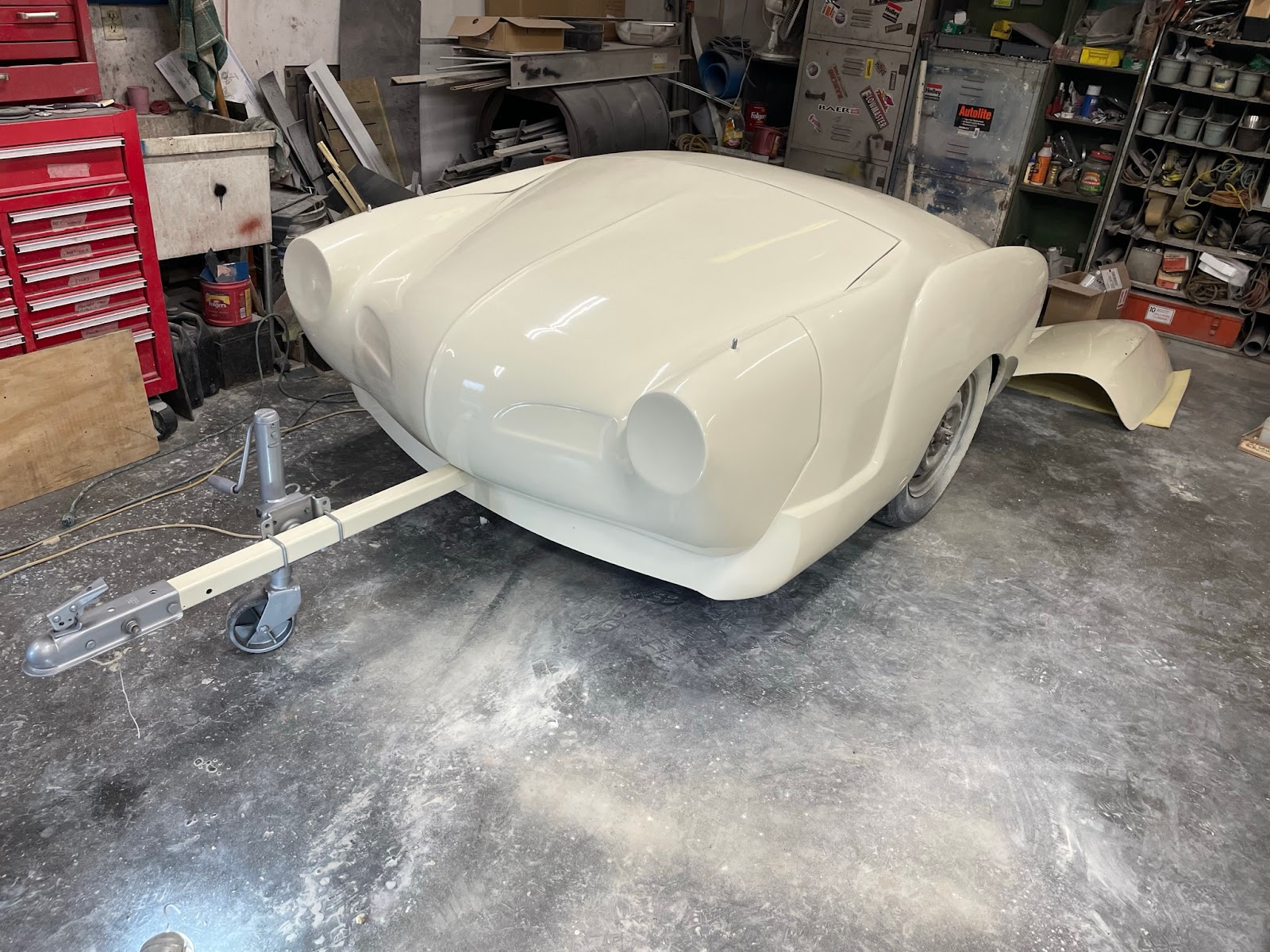
This is how I met Eleanor, after agreeing to adopt her as a donor of parts, and also as a shell that will hopefully be transformed into a long range trailer for the Karmann Eclectric.
A what?!
Yes, in keeping with the thoroughly eclectic, some would say bass-ackward nature of this project, I intend to transform the rear of this crumpled relic into a trailer that will enable the Karmann Eclectric to venture far from home powered by an aircooled VW engine, just as the good Lord intended. HowEVer, the power will not be transmitted through a transaxle, but by beefy wires. I plan to build an aircooled VW generator set by coupling the engine to a consumer grade 10 kW generator head. More details to come in a future post, but suffice it to say that I've got plenteous ideas.
A long range trailer is not a new idea, it's been accomplished in several forms, from the elegant generator trailer by AC Propulsion, to the diesel drivetrain of Mr. Sharkey's decapitated Rabbit. My inpiration comes primarily from the first generation pusher built by JB Straubel.
Though it would be simpler and probably easier to rebuild Eleanor as a pusher rather than a generator trailer, I desire the additional utility that a generator will provide, such as trackside charging during NEDRA EVents. Also, in the event of a blackout, the Karmann Eclectric will be able to provide quite a bit of household power, but when he runs low, Eleanomore can kick in.

But wait, all this has been done before! Karmann Eclectric needs something unique. And besides, Eleanomore came in much better condition than I was expecting. It would be a shame to use just her rear when only a front quarter is damaged... Well, from college road trip experience, I know that a six-foot male can fully stretch out inside the cabin of a KG, so why not turn Eleanor into a Karmann Ghia teardrop camper? Okay, eclectric boy, now you're really going off the deep end. You're turning a classic econo-sportster into an eco-freak racecar, and now you intend to add a trailer hitch and take it camping? Truly wacko! Yes, this should be fun......

Back in Grant's Pass, we managed to extricate Eleanomore from her bed of needles, and load her onto the generously-loaned custom car trailer that usually sees service under the White Zombie or Blue Meanie. Thank you John Wayland!
Despite the best advance measurements that my tennis shoes could provide, the trailer turned out to be about an inch too narrow for the Karmann Ghia. We set the car on blocks in order to clear the fender wells, and then securely chained her down. As you may imagine, this complicated the manual loading of Eleanor onto the trailer, and the fact that she had one locked wheel and one missing wheel didn't help a bit. Never mind, the neighborhood provided a couple of gawkers who didn't hesitate to provide unsolicited advice, so we got 'er loaded in a jiffy. Ross's generous dad is a retired hardware store owner, so EVery time we needed another wooden block, length of chain, or a come-a-long, he burrowed into the basement and came up with whatever we wanted.

The road trip home was extremely scenic and otherwise uneventful, and after leaving the carcass out front for a day to pique my neighbors' concern, er I mean interest, I unloaded Eleanor by setting tall timbers as an elevated runway, tied Eleanor off to a sturdy post, and drug the trailer out from underneath. She now sits under cover in my driveway, awaiting her date with the Sawzall....

Monday, December 12, 2005

Plasma Boy's School of Charger Repair

Sorry it's been a while, but that's not for a lack of EV activity, but rather the opposite.
Last weekend saw the arrival of the new-to-me PFC 20 Battery Charger. The Manzanita Micro PFC line offers what's by far the most powerful onboard and versatile battery chargers ever obtainable by the hobbyist, and are completely user-adjustable with regards to input and output voltage, amperage, time on, and to some extent, charging profile. My charger comes secondhand from a fellow hobbyist who never could let go of his Bad Boy charger, concerned that charging by genset might fry the precious PFC. Well, the Manzanita Micro website gives clear instructions on how to determine if your genset is safe, and the Creator, Rich Rudman was willing to provide full support to me as second owner, so it's a risk I'm willing to take, err..., make. (More to come on manufactured risk in a later post.)

So, under the guise of retrieving my loaned video camera from EV Racer extraordinaire John Wayland, known in battery-safety circles as Plasma Boy, I head for Portland with the new charger under my wing. It had arrived accompanied by a strange rattling sound on the inside, and I wanted a semi-professional opinion before powering up the silicon. When I arrived at the Wayland estate, John was putting the finishing touches on some long-postponed shop cleanup, and looking for approval, he asked my opinion. My reply; of "It's lookin' pretty good, so is that corner over there where you shoved EVerything?" was appropriately appreciated....

While talking over some design decisions for the KarmannEclectric, we got into holiday topics. The associated commercialism and artificial niceties of this season have made Christmas one of Mr. Wayland's least favorite seasons, but determined to gain his wife's good graces, our hero enlisted my assistance in the hanging of gaily-colored lights from his roofline. EVer-attentive to tidy wiring, John had permanently positioned plastic clips long ago to ease this annual installation. Well, about half of these succomed to the weather, snapping off in our chilled fingers. Determined to prevent this recurrence, out came the self-tapping screws, and we installed enough wiring clips to make Underwriter's Laboratories proud. The lighting set was old, with large screw-in bulbs, and we had to make many replacements, juggling the bulbs from socket to socket in order to keep the colors in line (red, yellow, green, blue, purple, redyellowgreenbluepurple, red...), and creatively hiding a couple of dead sockets. At long last, the house was festively festooned, and just in time to tackle the loose charger before dinner.

We quickly opened up the case, and discovered that the sturdy copper inductor posts would have to be desoldered in order to remove the circuit board and access the problem point. Johnny-on-the-spot whipped out his gun and a clever little slurpee that removes molten solder via vacuum. Once the inductor posts were loose, we carefully pried the board free. The problem was easily rectified by simply sliding the shims back into position and firmly clamping the inductors, making sure to reset the locknuts. As we went to replace the board, I innocently asked, "What are those tiny hairs of wire for?". It turns out that we had overlooked the temperature sensor leads, and yanked four miniscule wires right out of their little homes. Not a user-repairable item, we'll have to call on the maker for more....

Now, there will be those who think it was unwise to bring my technical problems to someone who's motto is "We break things so you don't have to!". But heck, it was a great learning experience, and who knows, maybe an upgrade to the old PFC 20 will be in the works, now that it's already opened up and EVerything.........

To top off the evening, John's wife walks into the shop, as if on cue. She starts straight into some family business, ignoring the eager anticipation on her husband's face. Somewhat crestfallen, he asks- "Didn't you notice the lights?" She doesn't miss a beat. "Yeah Dummy, that's the old set you were supposed to throw out, where are the nice new ones that I got last year!"

Sunday, November 13, 2005

A Battery of Cells.


That's right, my car doesn't have a bunch of batteries, only one- but it's made up of 280 individual 1.2 volt cells. These are no ordinary lead slugs, no, but nickel-cadmium wet cells. BB-600 spec, to be exact in US military parlance, as these batteries were originally purchased by Uncle Sam as starting cells for tactical jet aircraft. These little babies are rated to deliver 1800 cold cranking amperes, and each cell contains at least 34 amp-hours of juice. Nicads have many advantages over lead-acid cells, not least among which is their ability to fully recover from complete discharge. As a matter of fact, proper storage technique calls for running down the cells and shorting them out with a jumper! These cells have been proven to deliver beyond their rated capacity at 30 years of age, so why did Uncle Sam discard these cells after only three years on a shelf? Heck if I know, I guess that complete reliability is paramount when defending the free world, but I'll be happy to reuse castoffs like these anytime, for 1/464th the original cost, thanks to fellow EV'er Tim Humphreys, who scored of a truckload of these units in a surplus auction.
How to fit them into the Karmann Eclectric? Well, thankfully my battery boxes were designed for the maximum space possible, to fit even the 10 7/8" tall T-105 6 volt battery, that old reliable golf cart battery. The 9 1/4" bb600 cells fit quite nicely in my boxes, so snugly that one would thing they were designed for them all along...


The front battery box, shown above holding 64 cells (@ 220 lbs, once wired) was built by Doug Weathers for his Ghia, but when he decided on a different battery model, this one was surplused. The front pack is offset to the passenger side because the steering column passes too close on the right (and provides weight balance). There's room for a 10-cell stack on top of that filler plate if necessary. I like the clean look it has right now, but one thing to consider for optimal weight distribution is to get more batteries further forward. There's room in the trunk to mount a larger number of these cells atop a flat plate, rather than sunken into the gas tank void, as shown.
The main battery boxes are in the rear seat area. Here we have several options. Since the nicads have to be watered on a regular basis, easy access would be a plus. As shown here, 76 cells fit on each side with unfettered access. What you can't see is that an additional 25 cells per side are hidden from view. Additional trimming of the body wil be required to provide access for maintaining these cells, or I could just put filler in those inaccessible spaces. 101 cells per side, plus 64 up front gets us within 14 cells of our 280 unit goal. Well, it so happens that ten cells fit perfectly within each quarter panel, giving six cells spare.

With a simple box added to each rear quarter panel, 20 cells will be easily accessible for maintenance. And don't worry, even the quarter panels can be ventilated for proper Hydrogen management.

This shot also shows how the rear seat sidewall interferes with maintenance of the outermost cells of the lower rear pack. Enlarging the front pack and keeping the rear packs to 75 or 76 cells apiece would provide for not only better balance (ironically at the expense of a slightly higher center of gravity), but also eliminate the need to hack up my rear seat, and perhaps also reduce the need for small packs scattered throughout the car. Stuffing small cells into every available niche would seem advantageous, but it increases the chances for trouble with balance of charge due to temperature variations and numerous long interconnects. A single massive pack is better for battery management. Of course, compromise is the name of our conversion game, more to come after some head scratching...

The Gamera 9 is Born!


Who is Gamera, you ask? Why only a fire-breating turtle, hero of Godzilla knockoff movies and Guardian of the Universe. Okay dorko, so why'd you name your electric car motor after a Japanese movie monster? Well, it's green and short for one, it means business at both ends, it breaks stereotypes about the slowness of it's species, and since I matched the color of Zilla controllers, why not continue the naming convention? Long live the Gamera Nine!

Gamera 9 artwork courtesy of Andy Chung

So, the legendary motor finally came to life this week, unveiled before the gawking hordes at November's Oregon Electric Vehicle Association meeting. Well, the horde only consisted of @ 20 fellow EV geeks, but it was a great treat for Jim Husted of Hi Torque Motors to come on up and demonstrate the motor's innovative features to the club. Besides shortening the body to a compact 14.25 inches, (leaving less than 1/4 of airspace between the motor body and the ghia's rearpost portions) Jim threw in another first-of-it's-kind feature, series/parallel shifting within the same motor. That's right, The four field coils can be run as matched pairs, or one right after the other. At 12 volts, the effect was immediately apparent, as the motor drew 30 amps idling in parallel mode, but cut back to 18 amps in series. Series windings allow greater influence from the field coils, resulting in increased torque and lower amp draws, but at reduced speed. I still don't have a full understanding of the theory behind this, but I've sure seen the results in Wayland's drag racing, and now my motor will have a bit of the magic as well. The Adjustable Brush Ring assembly was run through it's paces as well, demonstrating the amazing tunability of a DC motor with 15 degrees of variable brush timing. At 12 volts and full advance, the motor started complaining and spitting carbon sparks, but at 170 motor volts and high rpm, it'll be very thankful for a little advanced treatment....
Here's a little wisdom from the Maker:
(Jim Husted writes)
"Wire size and turns are not the only things that effect coil / armature
relationships. How the fields are plumbed play a key role also. Jay Donnaways
motor is plumbed to be operated in either series or parallel."

In series the motor runs 1200 RPM @ 18 amps 12 volts, 0 load.

In parallel the motor runs 1850 RPM @ 30 amps @ 12 volts, 0 load.

"Every EV motor I’ve seen so far has been plumbed parallel, which gives you
higher speed, but less torque. Jay’s motor should put to rest whether going to
series will be beneficial or not. I believe that being able to switch the
fields to series would benefit those that face long or steep uphill drives.
Even if one could only get a 10 % improvement would that not be the same as what
some are getting out of regen? What I do know is that Prestolite used a two
speed motors (motors wired for both series and parallel) for years. If you were
going up a ramp the unit stayed in series as switching it over to parallel would
bog down the motor as torque dropped and the amps would skyrocket. I believe
this applies the same for anyone facing the same issues."


After the excitement of Gamera Nine's unveiling, this weekend's task was to 'dry-fit' the motor into Karmann Eclectric, seeing how well it slid into place, and how much trimming of the body would be required to do so.. Well, the good news is that practically none at all was required. The bad news, as you can see, is that I got a bit carried away and cut a big'ol slot for the motor shaft to slide through, which turned out to be rather unecessary. Of course, when I wind up installing some sort of accessory on that tailshaft, that slot will need to become much larger. Till then, the motor shaft will be visible, but reside below the stock decklid latch.

Installing the motor was fairly straightforward, but simplified since I left off the flywheel and clutch for this first test-fit. The extra clearance required by this hardware will indeed require me to lift the body whenever removing the motor, or go ahead with my earlier plans to make the rear valance removeable. Any new car, or motor for that matter, is treated with kid gloves until that first scratch, which I promptly inflicted with a little slide over my floor jack, removing @ 1/4" of powder coating from the motor's underbelly. Time to mix up a can of touch-up paint. Fortunately, I've already got the code for Zilla Green...

Thank you Jim Husted, burning rubber can't be far off now!


Monday, October 31, 2005

Need a bigger hammer?


My answer to this question is usually: "Then we must be doing it wrong!". Well, I hope this case is the exception. Shoehorning a souped-up Vanagon transaxle into my little Ghia was never supposed to be easy, but discovering that this particular tranny ain't compatible with the super-slick Gene Berg Bus-to-Bug transaxle adaptor kit wasn't the news I wanted. The other method that has been used is purveyed primarily by economy-minded parts vendors, who's aftermarket gear is stamped with the infamous Bugpack brand. Basically, one uses adaptor plates to mount the Vanagon tranny a couple of inches higher than stock, cuts a hole through the body, and runs a shiftrod across the top of the tunnel, usually elimating the parking brake in the process... Not a very attractive-sounding option. Armed with several negative reviews and a healthy dose of skepticism, I approached my local aircooled outlet: Autosport International
Jerry's been in business for over 40 years, supplying both the offroad and street rod VW scene, so I trust his recommendations. He introduced the 'spacer block' option to me, that rerouts the shifter rod back down into the original tunnel, but that would be second choice due to inevitable slop introduced by adding another linkage to the setup. The initially unattractive 'over the top' approach depends upon a sandrail-style shifter, which Jerry says is by far the most 'positive feeling' shifter on the market, and the only one he'd consider for speed-shifting a big bus tranny. Also, the instructions claim that the parking brake may be preserved by mounting the shifter at an angle, but I'm interested in fabbing up a custom yoke to pass the shift rod
around the emergency brake. It's either use one of these options, relocate the brake to an elevated bracket, put in an american-style pedal activated parking brake, or rely upon a hydraulic line lock and a prayer, backed up by wheel chocks...
So, emboldened by the wizened advice of a seasoned VW Guru, I plunked down the cash for a Bugpack Bus-to-bug tranny mount kit.
Bugpack quality was readily apparent, as I had to ream out four of the eight mounting holes in order to get things to line up right between my factory fresh transaxle and the never-been-crashed Ghia frame horns.. Now, say what you will about variances between hand-welded chassises, (sic) but such early obstacles do not inspire confidence in adaptor engineering...
The next order of business was cutting a hole to fit the nosecone through precious antique sheet metal. After careful measurement and a test-fit, the ole hole saw came out, and cut a hole only 1/4" off from where it should have been, which was easily corrected (after another test fit). Having recently demolished my Harbor Freight $16 sawzall in a demolition project, this opening had to be enlarged by hand. This was a good thing. With plenteous power, I probably would have hacked right on through the body/pan junction and purposely severed the rear brake line, as it looked like I'd need to open down to the original shift linkage inspection port in order to get enough clearance, and besides, I oughtta replace that brake line anyway.... No; hobbled by cramping fingers and my measly hacksaw blade, I took several swipes at the task, test fitting all along the way. A hump had to be hammered into the body beneath/behind the rear seat, in order to provide clearance for the tall and square bus tranny. Realizing that my grinding, drilling, hammering and manly grunting was echoing through the neighborhood, I closed the garage doors at 9pm and toiled in private... Upon the sixth 'dry fit', the transaxle slid home through an almost perfectly-sized opening, the brake line was intact and in it's stock location, the frame horns had been trimmed by only millimeters, and the body's new hump and hole would be hidden in the final product, yet also easily repairable should that be someday desirable...
(Experienced viewers may note that the lower adaptor is mounted backwards. Well, that's the only way the holes would line up. I'll have to get a bigger rattail file and realign the holes for a final mounting....)

Saturday, October 22, 2005

Virtually Finished


Well, after a few short days of electronic artistry and editing, the Karmann Eclectric can be viewed in all it's future splendor...
Thank You John at www.RODVISIONS.com

Saturday, October 15, 2005

Wheel we be able to see it soon?

You never know what's lurking just around the corner. Turns out that a new coworker's brother has an innovative business; http://www.rodvisions.com/ He creates artistic renditions of hotrods to assist builders in settling on and "selling" (usually to the wife) their ultimate custom car design.
It's great to mock up all options for your ride with the assistance of a professional artist! I'll post the results.

In the interest of showing design possibilities, here's what the ghia could look (kinda) like with the 15x6" Porsche phone dial rims.

Thursday, October 06, 2005

A motor field trip..


You've already read some of the exploits of our leading motor man, Jim Husted of Hi Torque Electric, but we've yet to meet the wizard. Jim's been reporting a lot of progress, so I took the opportunity to roll down to Redmond last Friday for a look see, and to sign off on some final design specs. To start off, this build began with an excellent core, a 1996 model 9" ADC motor, which lived an easy life pumping forklift hydraulics until the day that it's female splined shaft split open. Disassembly revealed no zorch marks or signs of overheating, so the motor probably could have been pressed back into service with only a replacement shaft. But no, it's only the best for Karmann Eclectric! To shorten this motor for easier placement in the Ghia tail section, Jim identified two inches of unused space inside the case and on the shaft, as shown below.


But wait, isn't that space needed for the fan and air circulation? Not really. Empty space of this magnitude doesn't help cooling a bit, and the fan was an extremely inefficient centrifugal blower, with rough-cast square vanes, mold release sprue and "aluminum ooze" nearly completely blocking several air passages. These blades will be hand-ground for aerodymamic efficiency, and the blower will be balanced for smooth operation. Through truing the fan, we can afford to shave a little length off of the collar that press-fits onto the shaft.
But the fan will be dealt with later. The case is our biggest challenge. This long beast needs to be cut down to size, and fortunately enough, Jim's lathe was barely big enough to get a good bite. However, our decision to leave the original motor mounting bracket in place nearly came back to bite us, as that sharp steel angle spinning only inches from our favorite machinist's hand threatened not only his safety, but the accuracy of his work, if the imbalanced piece were to migrate off-center. However, slow and steady cutting produced fine results over the next six hours.


Almost there.....


Finally, we have a shortened case, and enough steel spaghetti to secure the county jail.


So now this 9" motor case and endplates measure at 15 inches long, or only 1/4" longer than a stock 8" ADC, and 1 7/16" shorter than a stock dual shafted 9" motor. The adaptor is 3 1/2 inches deep, so we haven't quite made our goal of 18" after a dry-fit to confirm clearances, or lack thereof, so the next shortening method to consider will be the Reverend Gadget Flywheel Technique (which would require a lot of machining and some VERY precise welding. Dunno yet how feasible, let alone worthwhile that will be on this project. I may yet resort to cutting motor clearance into my precious antique German sheet metal (like EVery other aircooled VW conversion I've seen thus far).

Back to the EVents at hand. Jim also shaved down the motor endbells (aka: end plates), and in the process machined a press-fit centering ring on each end, making the plates pop on and stay stuck on the bench with nary a bolt. How's that for precision work!
The man and his machine are of course, introduced in our opening photo.

The main decision of our day involved locating the motor's wire connections, or terminal posts.
Most EV-sized series DC motors have four posts, with one set at each end for the armature and series windings, and these two may be as much as 180 degrees apart from each other, as shown in this excellent schematic by Cloud Electric. I decided to cluster all four on the tail end of the motor, in a position as to not interfere with the original mounting bracket and possible accessories, yet easily accessible for maintenance, modification, and voltage measurement.


Here's a small golf cart motor with terminal
layout similar to what the Karmann Eclectric
will be sporting. Terminals S2 and A2 will be connected by a short busbar, instead of a wire stretching across the entire motor. Of course, placing the terminals so close together may increase the risk of an accidental short, so some shielding material between the posts may be in order.


Doug Weathers joined our shop session, and took to test-fitting the various adaptors I've acquired for possible usage in the Karmann Eclectric. Here, he and Jim are figuring out the trimotor adaptor originally intended for the Ghia Monster. It's a beautiful piece of machining, but besides being overkill for Karmann Eclectric 1.0, this design didn't take advantage of the motors' C-face mount, which is essentially a press-fit ring on the motor endbell. Instead, it relies only on the motor bolts for centering, which may be slightly less robust. Anyway, the 9" Electro Auto version shown next is simpler, has a perfect C- face mount, and will keep things clean (at least untill I go overboard on accessory drives). The trimotor adaptor goes back into the reserve bin...
Our last order of the day involved cosmetic concerns. Marko Mongillo's Prestolite rebuild for the Fiamp was in line right in front of me, and luckily enough, he served as the Guinea Pig for fun with powdercoating. Learning from a bit of rework on Marko's motor, we were confident to coat the endbells in a Mercedes Silver powder, that should give a finish very close to the original aluminum sheen, but much more durable, shiny, easily cleaned, and electrically insulated. For the motor body, we custom ordered a batch of Zilla Green, to match Otmar's fine controllers, which the Karmann Eclectric absolutely must have. For optimal appearance, my motor didn't need the orange peel and ground-off welding seam that industrial motor cases show, so we decided to machine down the outer surface just enough to get everything smooth, while also truing up the cylinder. This may also provide an immeasurably small efficiency benefit by evening out the magnetic fields. But wait, how can we turn the motor case with that big bracket welded to the side? Okay, time to cut it off. Before cutting it off, Jim will drill and tap four new mounting holes for the bracket, and to keep the steel symmetrical and provide yet another option for accessory mounting, four mirror-image holes will be installed on the opposite side of the motor.
So, we should soon have a shiny and smooth Zilla green motor case with slick silver endbells. All that's left to do is decide on the length of that pesky, but hopefully useful tailshaft.....

What's in a name?


You may have gotten used to the "Karmann Eclectric" name by now, an admittedly clever creation with an altogether certain connotation. What were the other options? I started off with an obvious tribute to a rocker about which I know nearly nothing, by dubbing the project Karmann Electra. Cute, but maybe misleading...
The simple "Karmann Electric" was obviously too-- simple.
So what honors the car's original builder, it's new powertrain, and combines the quirky nature of both? Nothing short of Karmann Eclectric would do.
So how to present this new twist on an old name? By simply twisting the old logo.
In keeping an eye on the EV Trading post, I noticed an electric VW Bus built by Mark Schane-Lydon for sale. He's a computer graphic artist and filmmaker by trade (www.monkeywork.com), and had put together a nifty "Voltswagon" logo
in the original style font for his van. I asked if he might do the same for the Karmann Eclectric, and refusing any compensation, 'ol Monk threw one together in a jiffy! A slightly more eclectic version is forthcoming, but I'm really stoked- this is just the kind of one-off touch that I was looking for.
Thanks big time, Monk!
PS-And here it is, maybe the final version, stay tuned...

Sunday, September 25, 2005

Bringing up the rear.

So you've already seen that I intend to stuff a Vanagon transaxle into my little Ghia, but the bastardization is far from finished. To transmit massive torque from motor to wheel there are several links to consider. Downstream of the transmission gears are the axle half-shafts, constant velocity joints, and stub axles (in other words, the "axle" part of transaxle). The inner and outer CV joints of a Type 1 VW (Bug and Ghia) are reliable at design loads, but could spew bearings faster than a Navy navigator on Sodium Pentothal if subjected to 300 foot-pounds of torque. Besides, the Vanagon used larger CV joints than my little Ghia came with, so something larger is needed to match things up. Duh, use Vanagon parts, right? Well, turns out there's more to this story. With joint-jolting torque propelling an overweight Ghia to illegal velocities, brake components become critical. No way would I trust my tushie to the skinny rear drum brakes that came as stock, so let's get some vented disks. Besides, we want beefier CV joints and axles. CV options are nicely laid out at Blind Chicken Racing. Oh yeah, if all this stronger stuff came in a lighter package, that would be nice too. Sound like an impossible order? Not if you consider the dynamic duo of VW and Porsche. Porsche has aways done a lot of the big-brain engineering for VW, and would naturally not waste that work when it came to building their own cars. It turns out that Porsche 924 and 944 cars have essentially the same rear suspension type as late model Karmann Ghias! Plus, the 924 and 944 models up through 1986 had a narrow track, using trailing arms of the same dimension as Type 1 Volkswagens. However, these arms used the beefier Type IV (411 and 412 station wagon) CV joints. The Type IV joints share a common diameter and bolt pattern with the Type II bus joints, but they have a greater range of motion. Since I've considered airbagging the Ghia, this is a welcome bonus. What about the brakes? Porsche uses only the best, so the 924/944 line came with vented rear disks and an integrated parking brake. Ok, so this sounds heavy. Yeah, the 944 trailing arms were beefy steel to support a heavier, higher performance car, until 1986, that is. In 1986, Porsche produced a one-year-only narrow track, forged aluminum trailing arm. For yet another bonus, these arms are compatible with the 944 Turbo (951) four piston Brembo calipers, or the earlier two piston calipers. Since I'm trying to avoid boosted brakes for reasons of mass, bulk, and complexity on an electric car, only the early calipers would do.
Long story short, I locally located the rear end of a 1986 Porsche 944 Turbo and a set of early calipers. For properly balanced braking, I pulled a master cylinder from the same, and it turns out that once separated from it's booster unit, the master cylinder 'looks' like it will be a perfect match for the Type 1 mount, only in aluminum instead of cast iron, and properly portioned for rear disks without the need for an external proportioning valve.
Before you get too impressed by my intellect, be assured that it's been figured out by much better mechanics than me. I was particularly inspired by the work of Germany's Jochen Bader, who stuffed the internals of a Porsche 993 into his Ghia, and used much of this rear suspension setup. A good article on the project can be found at http://www.bader-racing.de/en/presse/volksworld.pdf

Our last link in motor-transmission-axle-brake rotor chain is of course, the wheels and tires. Tires are a fairly forgiving component, as evidenced by any number of roadgoing monstrocities these days, from rice racers with their 13"x13" rims and rubber-band tires, to the 35" mud grips found climbing curbs at any suburban shopping center. For the Karmann Eclectric, we want to find a balance between traction and efficiency, style and substance, while keeping it within the wheelwells of my narrow-waisted Ghia, allowing unassisted steering, stock speedometer ratios, and the many other benefits retained through generally staying true to what those Porsche engineers spent so much time figuring out. The perfect compromise may well be 6"x 15" rims from the front end of 1987 924S LeMans Special Edition models. Not only are these rims the right size, with the right offset, and the right bolt pattern, but the Porsche Phone Dial design is of timeless simplicity, with oval holes that smartly complement the Ghia lines. Of course, my local Porsche parts scrounger happened to have a bargain on four of these....


More details to come on the technical specificalities that were glossed over in this post.

Friday, September 23, 2005

Monster Trans-action


It's hee-eere! After no fewer than 22 days of delay by UPS, the 091 Vanagon transaxle originally built for the Ghia Monster has arrived! Yes, the Ghia Monster, that most extreme of electric Ghias, outgrew it's bulletproof, locking differential, five speed overdrive with a granny first gear tranny before it even got installed. Steve Marks had this beauty built up by KCR transmissions (who apparently don't keep records of each tranny built for later reference!?!) early on in the Ghia Monster project, and then it turned out that the Ghia Monster would produce too much torque even for the beefiest aircooled factory transaxle available. To handle over 1000 foot-lbs of torque, the Monster needed a Lenco. However, Karmann Eclectric should 'only' put out about 300 foot-lbs, so this gearbox should fit the bill. There's some confusion between the builder and original buyer as to whether or not the 5-speed kit was installed, but that will be apparent soon enough. An electric Ghia would only need fifth gear for a salt flats run, anyway....

Ever since the engagement was called off, this jilted tranny had been sulking in storage under the stewardship of Richard Brown, EV mentor and creator of the Dualin 7. Rich consented to ship it up to me gratis, and built a custom shipping crate that would've survived a trip around the horn on a slow boat to Timbuktu. I'm thankful for his careful craftsmanship, because despite the conspicuous ^UP^ markings, the crate obviously spent part of it's three week journey in the inverted position (evidenced by the handwrittern upside-down UPS notes to staff....).

You've no doubt noticed that this gearbox came with some shiny accessories. Yep, I got the adaptor plate too. But this is no ordinary spacer ring, no. Steve had designed and built a very cherry and custom standoff plate to accomodate three 8" ADC motors! It fits perfectly into the Ghia engine bay, and the temptation to make use of this plate is too great. Just as Steve discovered, three motors would probably be overkill for this transaxle, but those slots in the adaptor plate are also perfect locations for any number of accessories, such as an AC generator head, or rotary inverter (more economical than the electronic kind, if not quite as efficient). Another possibility is a high-voltage DC generator, for the most efficient regeneration and dynamic braking possible, and there's always that leftover alternator that I've got hanging around, for an old-school and much less expensive DC-DC converter. "All" that has to be done is to drill a new set of holes for the larger 9" motor mounting pattern, and then it's off to the races.. Oh yeah, the coupler spacing doesn't appear to be quite the same, and then I'd have to rethink the controller location, and those contactors, and there's the water cooling, and, uh..........

Wednesday, September 21, 2005

Back to the Beginning.

I got a bit ahead of myself with that news on the motor build.
When we last left our little yellow victim, it had been rescued from backyard oblivion, but we were discovering the unusual rust patterns that come from being closed up for 20 years in a humid environment. Besides a sheen of surface corrosion all over the interior, the big problem was in the floorpans. The natural jute padding used by Karmann was a great sponge, and kept moisture on the floorpan for decades, as they rusted from the inside out. What looked like a clean floorpan from below quickly crumbled with a gentle poke from my screwdriver. So, the pans have to be replaced. Since I was determined to build an EV, why not build custom reinforced battery boxes into this new pan? I gathered some 'worst case' battery dimensions and used up cores of batteries that I might use, such as the old standby flooded 6 Volt Trojan T-105 and the high performance absorbed glass mat Optima Yellow Top.
I measured clearances on the original floor pans, and sketched out some new pans that would hang a bit lower, since the Ghia had a very generous 8.5" ground clearance to begin with. This would be reduced to a minimum of 5", which very rarely scraped on my Miata, and would allow the tall T-105 to sit completely beneath the rear seat are on my Ghia.
Then it was time to remove the body, which was surprisingly easy, and start hacking!

Since the floorpans were coated with tar, it was hard to gauge the full extent of corrosion, and I wound up needing to cut farther than originally anticipated.
Quality replacement pans don't come cheap, and I already knew that stock pans wouldn't fit the batteries like I wanted, so a local welder agreed to tackle the job. We found that 1 1/4" square tubing was a perfect fit inside the chanel that runs around the perimeter of the pan, so we added it there for reinforcement in the critical rocker panel area, and also added a cross brace that would serve as the front edge of the battery box. From the front of this box, we angled back up and forward to the remaining original pan, and joined the two with a strong lap weld. Custom seat mounts were fabbed up,TIG welding was done all around, and the quality of that work was outstanding. Thanks go out to Rogers Welding of Woodstock, GA.

After welding, the entire chassis was sandblasted by The Dutchman of Woodstock, GA, and then the raw metal was given a thick coating of Line-X, except for suspension componenets, which I spraypainted with Hammerite.

Building a motor

As they say, good things come to those who.... procrastinate?
After scrounging parts for two years, and showing up late for every good deal on a used Advanced DC or WarP motor that came along, I was resigned to paying retail, when out of nowhere, the nation's most imaginative DC motor rebuilder appears in my back yard! Jim Husted of High Torque electric might be found in any industrial town, a talented motor man who'd been rebuilding industrial DC drives and golf cart motors for decades, but he was discovered on John Wayland's forklift repair route, and has awakened to the wild world of EV racing. In less than a year, Jim's creations have turned conventional EV motor limitations into history. With the Siamese Eights for White Zombie, Jim built two eight inch motors around a single shaft, and this motor is already pushing the Zombie to incredible 0-60 foot times (1.671 on it's most recent run). A smaller diameter motor will always 'spool up' faster than a large motor, and the Siamese Eights have doubled that advantage, without the attendant inefficiencies of combining gears, a belt drive, or vibration-prone couplers. Jim's next creation was the "Purple Phaze", a massive old 72 volt Allis-Chalmers forklift motor that was pulled from a scrap heap and has become a gleaming source of axle-snapping torque at 348 volts. Not satisfied with just a clean build at nearly five times the original design voltage, John Wayland and Jim Husted collaborated to develop the ABR, or Adjustable Brush Ring. This simple assembly makes advancing or retarding the brushes on a series DC motor possible with the simple flick of a lever, and it could even be automated using a servo motor. Adjustable brush rigging promises to allow the same motor to efficiently push a car in commuter mode all week, but still tear up the track on Friday night. With retarded brush timing, the elusive goal of practical regeneration on a series motor appears to finally be in reach.
Jim's second ABR went into Doug Weathers' 8" ADC motor, and his third is reserved for the Karmann Eclectric. Better to let the description come from the builder himself. Here's Jim's first mention of our project on the Electric Vehicle Discussion List:
+++++++++++++++++++++++++++++++++++++++++++

Hey everyone

Mark wrote:
>So far everyone says it's not too big. Guess it'll be a go on the 9" motor.
James Massey wrote:
Aah, don't forget that there is more than one choice in series DC motors of
that size. Advanced DC, Netgain, Warfield, GE and others. And don't forget
the Jim Husted special build options. Jim, have you a suitable motor available?


Actually I have about 5 or 6 more 9's available to me. I just figured I’d let
you all feed on him for a while (or maybe the other way around) before I piped
in. Since James brought me into this, I guess I have to add my two cents here.
I think my current project might offer you some food for thought…


I just got the Okay to start my newest project, which will be a shortened 9” ADC
for a conversion in Vancouver WA. This motor will be shortened down to 15” in
total length by removing 2” from the housing area. The shaft will also need to
be modified, and as I’ve followed these posts would allow an extra 2” of tail
shaft to stick out for one of your needs. The end plates are going to be clear
powder coated for a nice easy to clean finish. These modifications are so the
motor will fit into his conversion without having to cut his car.


This motor will sport an adjustable brush ring (Notice: I’m naming this an ABR
for short lol). For this conversion it will be static, as in advanced by the
user for his /her car and locked into that advancement. If one were to install
a servo motor to the adjusting arm of the ABR, then could you not get it to
slide from neutral for regen, to a pre-determined advancement for driving, and
then back? Making the ADC a little more regen friendly. This seems so doable,
any input?


I’d like to note that the ideas and the modifications I am beginning to do have
come in large part by the suggestions and ideas of others, in addition to
reading your posts. I’m hoping to get a web site up where I can post pics of
cores looking for good homes. I plan to put up how to’s and show off what we
got cooking in the pots as time goes by. I will throw up step by step projects
for those both here and abroad who might like to do it themselves.


I’ve heard mention of someone wanting to be able to afford one of my motors and
just so those out there know, the above described ADC 9” was quoted below the
cost of a new 9’er (any future mod’s may adjust this, lol). Just so you know I
to am not going to get rich at this, but instead am trying to do my part as a
member of this community while adding some spice to my kinda boring forklift
customers. If I’m lucky I can skim off some money for my own little EV racer.
If you haven’t been there go and check out John Waylands page. The Siamese 8 is
a pair of motors John and I had fun with.

http://photos.plasmaboyracing.com/buildsequence


This is a great site isn’t it! There’s one problem though! They won’t tell you
how to shut the damn EV thingy in your brain as you stare up at the ceiling
thinking of new and crazy stuff, lol.


Anyways welcome to the list


Jim Husted

Hi-Torque Electric

Redmond OR.
++++++++++++++++++++++++++++++++++++
Nuff said, eh?

Monday, September 19, 2005

Make a what outta who?

After almost two decades of daydreaming about electric cars, discussing their merits with friends and family, and watching fickle automakers develop promising prototypes and even launch a few kickass models, such as GM's EV-1, just to pull the rug out from under loyal leaseholders, I decided to take the plunge in the fall of 2003 and build my own electric car.
Having had a long love affair with the Volkswagen Karmann Ghia, my choice of a car to convert was obvious, but two years of lurking on the Electric Vehicle Discussion List cemented my selection. At least eight electric Ghias have been built, giving me some experienced peers to learn from, and the Type 1 Karmann Ghia has a lot of what's desirable in a 'glider', or a vehicle ready to repower.
Here's a few examples of other electric Karmann Ghia projects:
Scott Cornell's 1965 Coupe
John Bryan's 1971 Coupe
Doug Weathers' 1971 Coupe
Texas State University student's 1972 Coupe
Steve Marks' Ghia Monster (a radical drag-racing electric Ghia)
Cliff Wilson's 1969 Coupe
EVChallenge demonstrator, The Ghost Dancer, a 1965 Karmann Ghia Cabriolet

I now own the Ghost Dancer, but sadly only acquired it after an incident of 'battricide', after which the electric components were stripped out and sold. Electric car batteries continue to be the greatest obstacle to widespread EV adoption. Many hobbyists have experienced the expensive learning curve involved in proper care and feeding of their battery pack. Pack replacement costs are akin to replacing an engine, from $1000 to $2000 for the cars pictured above, and more if using a battery chemistry other than lead-acid. The Ghia Monster is running on gasoline again, perhaps to be reconverted someday...

The Ghia shared most mechanical components with VW Beetles, so not only are parts plentiful and economical, but many upgrades are available. Also, since Porsche did much of VW's design work, the Ghia can swap parts with an astounding number of cars, well into the modern era. The car's curvaceous lines harken to it's 1950's birth, and the hand-welded coach construction of an even earlier era provides strength while preserving interior volume in a supple structure that soaks up the rigors of the road. I built my first Ghia during high school, taking over dad's garage for the better part of two years, and that car served as my college driver, putting in another 100,000+ miles of service before it's cancerous condition caused me to pass it along to another eager restorer.

Bye Bye, Blue Baby... chassis # 1442446696, owned 1989-2003

But of course, another ghia was waiting in the wings.
This 1971 coupe, soon to be known as the Karmann Eclectric, was discovered under twenty years of dust in an Atlanta lawyer's spare carport. Still sitting on dryrotted 1983 retreads, this one-owner car was cancer-free in most of the usual spots, but had a couple of unusual problems, such as rust on the nose where it had stuck just a few inches out into the weather, and rust above the headliner, where two decades of southern humidity had loitered.


web counter